“You’re Doing It Again”: Two Years Of Pressing The Same Knot In My Shoulder Blade, And The Clue My Neck Gave Me
Two years of massages, tennis balls and heating pads, and the knot was back in the exact same spot every time. Then a physical therapist pressed two fingers into my neck, and I felt it in the knot.

My husband said it so gently that I knew he had been waiting a while to say it.
"You're doing it again."
We were stopped at a red light. One arm was crossed up over my chest, fingertips hooked over the top of my shoulder, pressing back toward the knot at the inner edge of my shoulder blade, the spot I had been working on for two years. I hadn't decided to do it. My hand had just gone there, the way it goes to a pocket for the keys.
"How long was I doing that?"
"Since the grocery store," he said. Then he told me the rest, the way you list things you've been trying not to say. The doorframe I leaned into when I thought nobody was looking. The corner of the hallway wall I backed up to and rubbed against, which I would have been mortified to explain to a guest. The tennis ball in my coat pocket. The way I'd stop in the middle of a sentence, roll my shoulder, and let out a little breath.

I could find that spot in the dark, right where the blade meets my spine. It feels like something solid pressed into my back. It's tight when I wake up. By evening it burns. Some afternoons it sends a line of pins and needles down my arm.
What I couldn't tell him was that I had been fixing it the whole time. Again and again I had gotten it to stop, for a day, for an hour, for forty minutes. Somewhere in there I had quit asking when it would go away. I had started asking when I could next make it stop, which is a much smaller question.
And every one of those fixes had worked. That was the part I should have noticed. It took a salt shaker, one Sunday at our own dinner table, before I did.
Sleeping Position. Stress. A Rhomboid. Everybody Had A Name For It.
Nobody else noticed it either. They were too busy giving it a name.
The first person to name it was my doctor. He pressed on it for about four seconds and said it was probably the way I sleep. I bought a contoured neck pillow that week. The first morning on it, the knot was already there.
A friend said stress. She meant it kindly.
A physio I saw for six weeks called it a rhomboid strain and sent me home with a stretchy band and a sheet of exercises. Squeeze your shoulder blades together. Hold for five.
Somebody online said sit up straighter. Everybody said stretch more.
I want to be fair to all of them. Every explanation came with something to do, and I did every single thing.
But here is what two years of doing what I was told taught me. It didn't matter whose explanation I believed that month. At the end of the month the knot was in the same place.
Somewhere in the second year I stopped asking. I'd half decided this was just how my upper back worked now.
A Day. An Hour. Forty Minutes. I Could Tell You How Long Every Fix Lasted.
On a bad day it doesn't feel like a knot. It feels like a nail pressed into my back. This is what I had been doing about it, and what each one bought me.
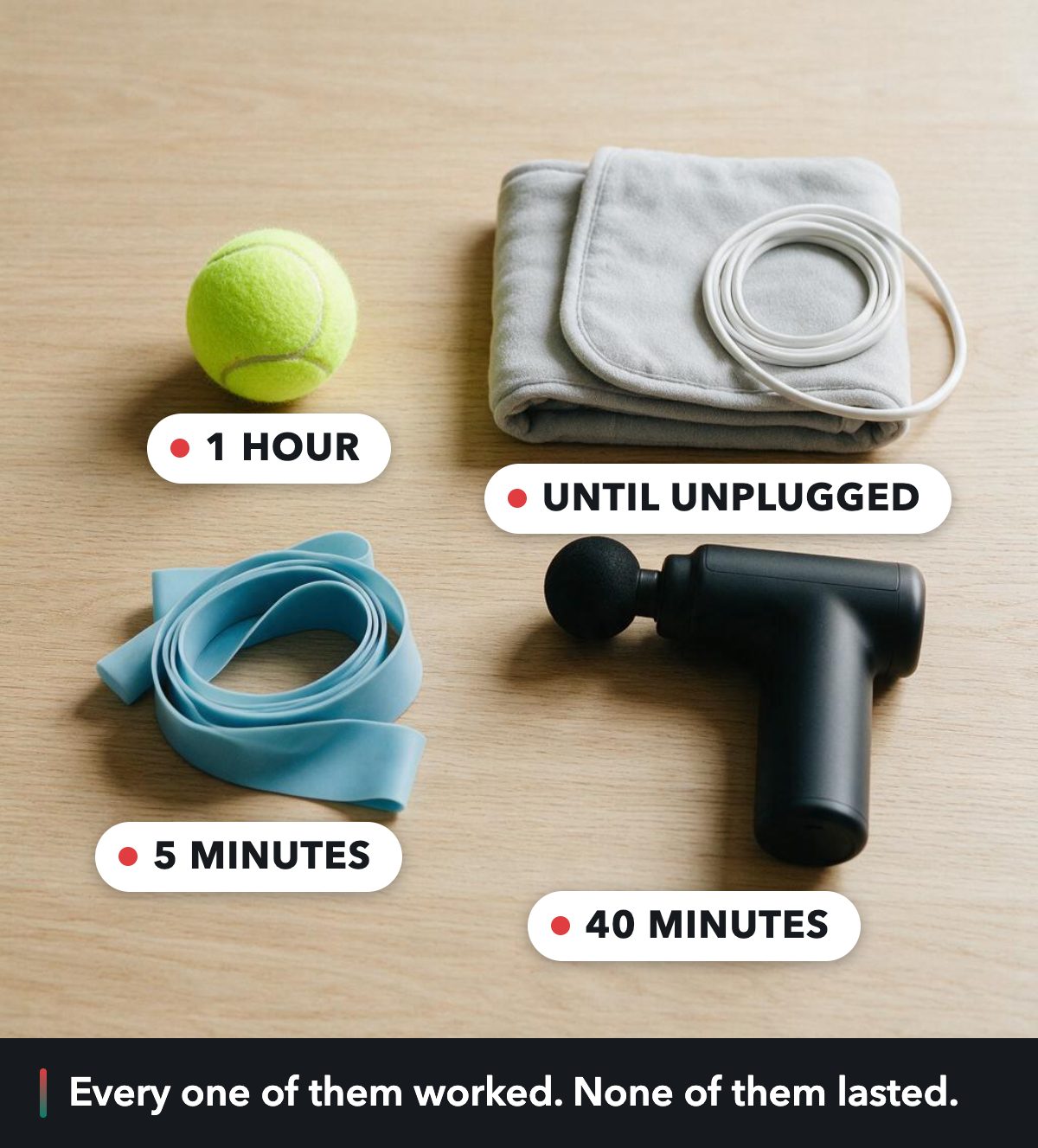
And every time one of them worked, it felt like proof. If working on the place that hurts makes it better, the problem has to be in the place that hurts. So I worked on it again.
Then it came back. Not near the spot. The spot. Same place, to the half inch, like something was putting it there.
Then I Reached Across The Table For The Salt, And My Hand Went To Pins And Needles.
It was a Sunday. We had friends over for dinner.
I reached across the table for the salt, a thing I have done ten thousand times, and halfway there my fingers went to pins and needles. The salt shaker sat in my hand like it belonged to someone else.
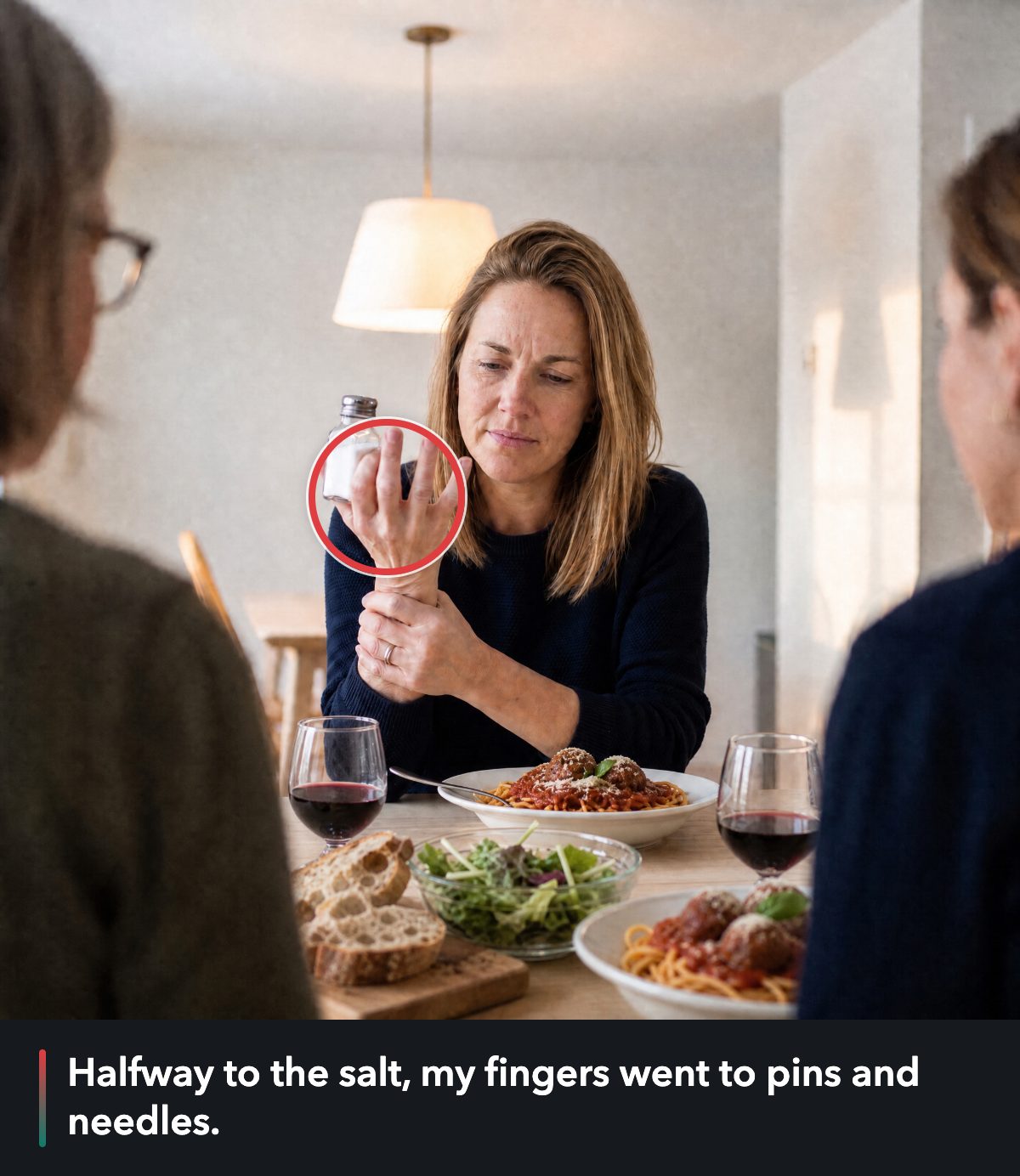
I put it down and finished my sentence. I don't remember a word of it.
Because what I was thinking was this. I had been digging at that spot every day for two years. Digging hard. A ball, an elbow, a machine. What if I'd been making it worse?
That night I did something I hadn't done in two years. I didn't look for a way to make it stop. I looked for somebody who could tell me why it kept coming back.
I found a physical therapist who only works on necks.
She Didn't Press On The Knot. She Asked Where I Felt It.
She watched me move for a few minutes. Turn your head. Now the other way.
When I turned my head to the right, the knot answered. Same spot as always.
"Your shoulder blade didn't turn just then," she said. "Your neck did. That's a clue the neck is involved."
Then she stood behind me and pressed two fingers into the back of my neck, well above where it hurts.

"Where do you feel that?"
Not in my neck. In the knot. The inner edge of my right shoulder blade, right where it meets the spine. The spot I could find in the dark.
In two years, nobody had pressed somewhere else and asked me that. My doctor had pressed on the knot itself, for about four seconds.
"Right," she said. "Now look at this."
She pulled up a picture of the bones in the neck, with nerves coming out between them like the roots of a tree.

- 1A nerve can get squeezed in your neck, either where it leaves the spine or on its way through the muscles at the side of the neck. When it does, it starts here.
- 2You feel it at the inner edge of your shoulder blade. That is where the pain shows up.
- 3Other nerves from the same place in your neck run over the shoulder and down your arm. So it can also show up further down, in the arm or the hand.
"These nerves don't stay in your neck," she said. "They travel. This one usually comes off your spine up here, at the fifth nerve root in your neck, and runs down to the inner edge of your shoulder blade. It powers the muscles you've been digging at for two years. It's called the dorsal scapular nerve."
"Where you feel it is the end of the wire. If it's pinched, it's at this end."
 The pinchWhere you feel it
Why The Knot Let Go Every Time I Dug At It, Then Came Back To The Same Spot
Then she said the thing I have thought about every day since.
"I don't think that muscle is tight because it's weak," she said. "I think it's guarding."
When a nerve like that gets squeezed, she said, the muscles it powers can go on guard. They clamp down to protect the area, and they stay clamped. She thought that was my knot, and why it felt like something solid under the skin.
"So when you dig at it, the muscle lets go for a while, because you're forcing it to. That's your relief. But if the nerve is still being squeezed up in your neck, it sends the same signal straight back, and the muscle clamps down again. In the same place. Every time."
I sat there and went through my whole list in my head.
Every one of them had worked. My husband had watched every one of them work. And every one of them had been aimed at the end of the wire.
The massage loosened the end of the wire for a day. The tennis ball, for an hour. The theragun, for forty minutes. The heating pad, for as long as it was plugged in. Every one of them did what it was supposed to do, at the end that hurts.
That was my answer to the question from the dinner table. Not whether I'd been digging too hard. Where I'd been digging.
Then she asked about the pins and needles.
"That fits," she said. "The shoulder blade is often the first place it shows. The hand can be weeks behind it."
Fifteen Minutes On Her Table. The Next Morning, My Thumb Found Less There.
She didn't touch my shoulder blade at all that day.
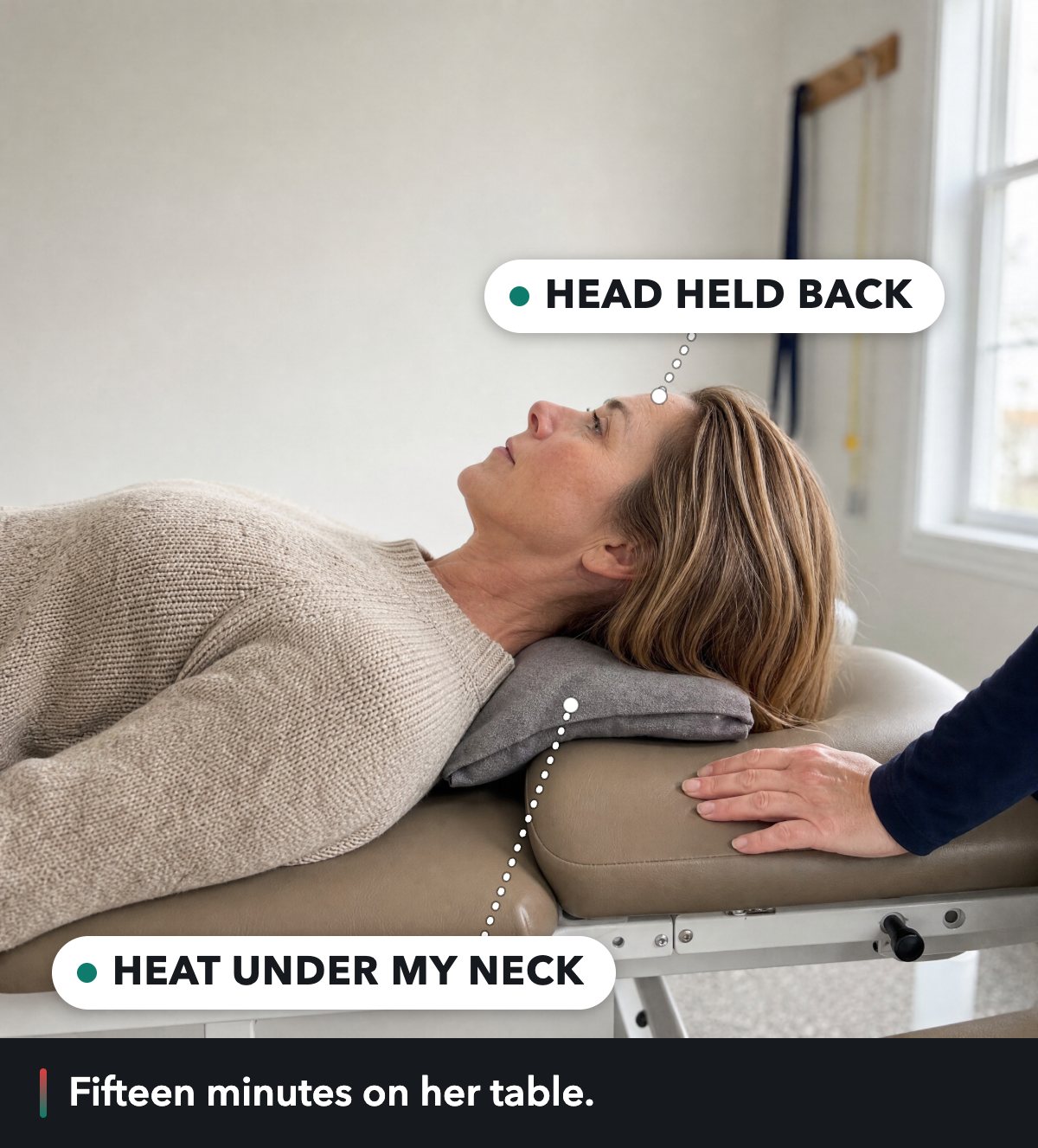
She had me lie back on a table that cradled my head and drew it back, slowly and steadily, with heat under my neck. Then she worked on the muscles either side of my neck, nowhere near where it hurts.
Fifteen minutes. I nearly fell asleep.
I want to be careful how I say the next part, because I know what it sounds like.
The next morning I did what I do every morning before I'm properly awake. My hand went back to the spot.
There was less there.
Not gone. Smaller, and softer, and when I pressed it I didn't get that bracing feeling.
Two years of working on the place that hurt, and the first real change came from somebody working a hand's width higher.
Two Or Three Visits A Week, At Up To $150 Each. We Did The Math At The Kitchen Table.
Then she told me what it would take to keep it that way.
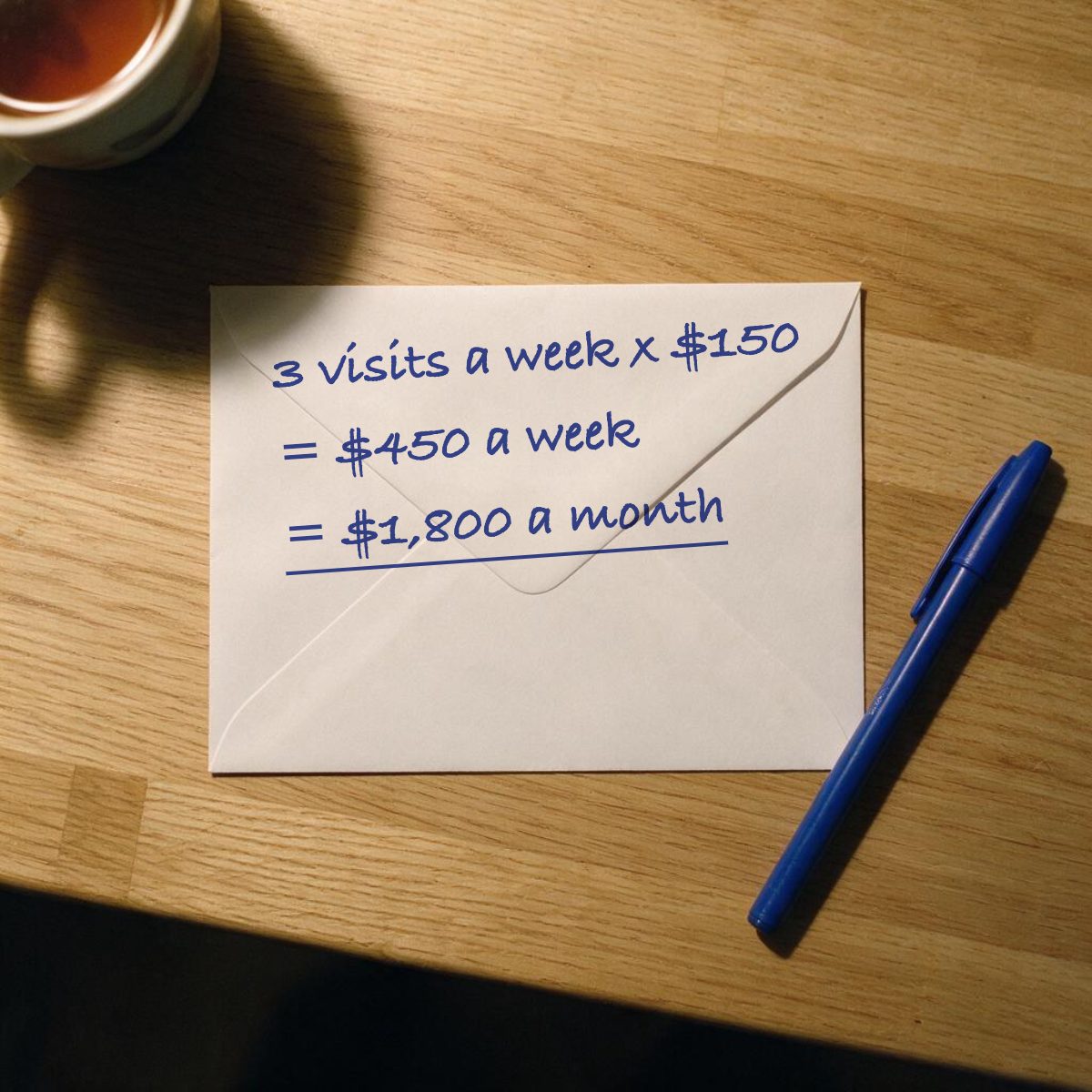
Two or three sessions a week, for a while. Somewhere between $80 and $150 a session, depending on where you go. Forty minutes each way in the car.
That night my husband did the math on the back of an envelope. He wrote down the number and turned the envelope around so I could see it.
I wasn't going to say no to it. But I know myself. I'd have gone for three weeks, felt better, missed one, then missed two, and been back at the tennis ball by Christmas.
So I went back to what she had actually done on that table. Three things at once. Something that held my head back at an angle. Heat under my neck. Work on the muscles either side of it.
If I could get those three things at home, there would be no appointment for me to miss.
I Already Owned A Massage Gun And A Heating Pad. Both Were In The Drawer Next To My Bed.
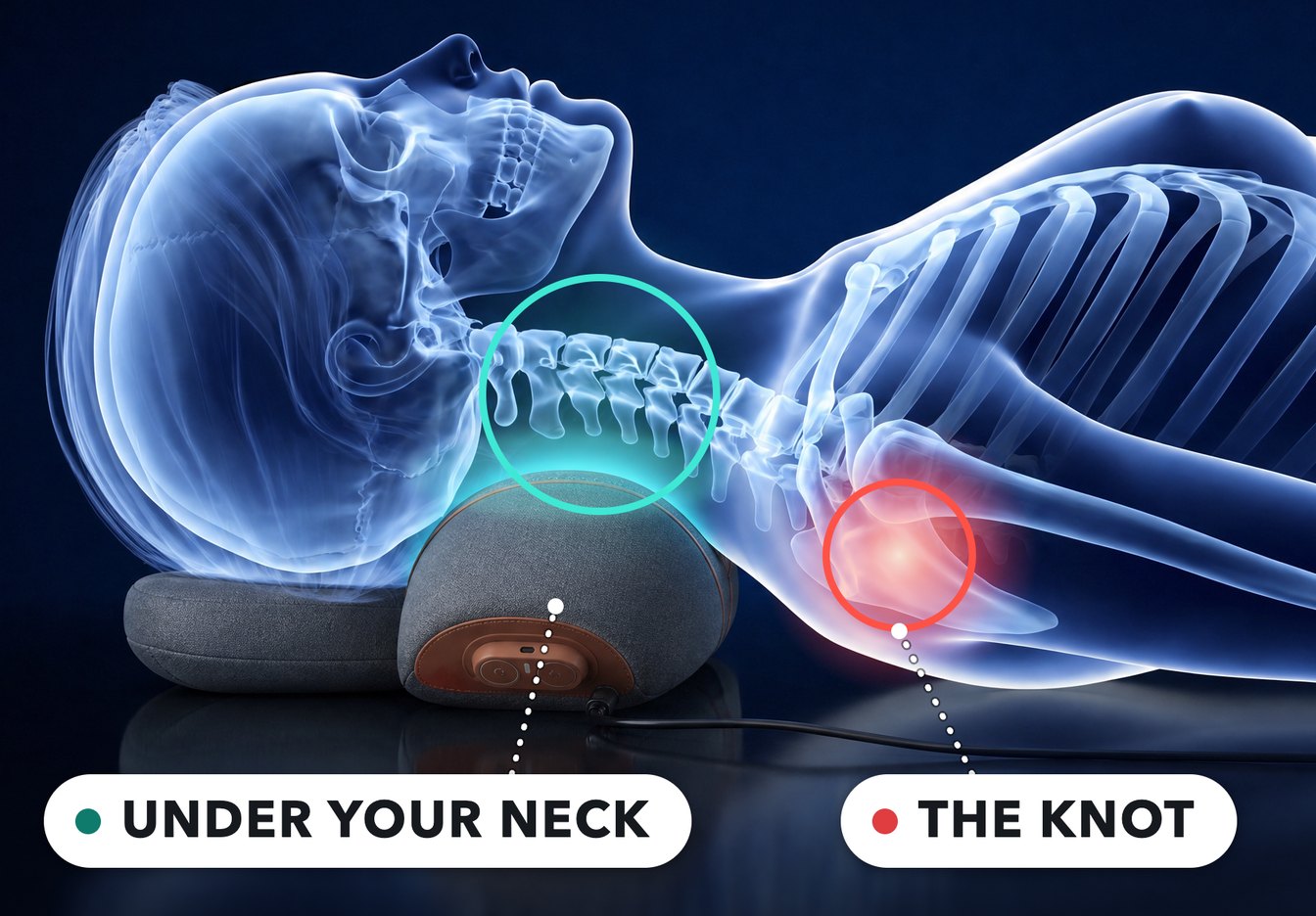
I found it that night, on my phone, in bed. It's called a FisioRest. It puts an angle, heat and vibration into one thing you lie back on.
It looks like a neck pillow. I'd bought one of those the week my doctor blamed my sleep, and it lives in the closet now. A pillow holds your head where it already is. This one holds it tipped back, with heat and vibration while it does.
It isn't her table, and it isn't her hands. It can't tell you what's going on in your neck. Only someone like her can do that. But I could lie back on it most evenings, without the drive.
The heat and the vibration didn't impress me at first. I already had both, and I had used both on my shoulder blade.
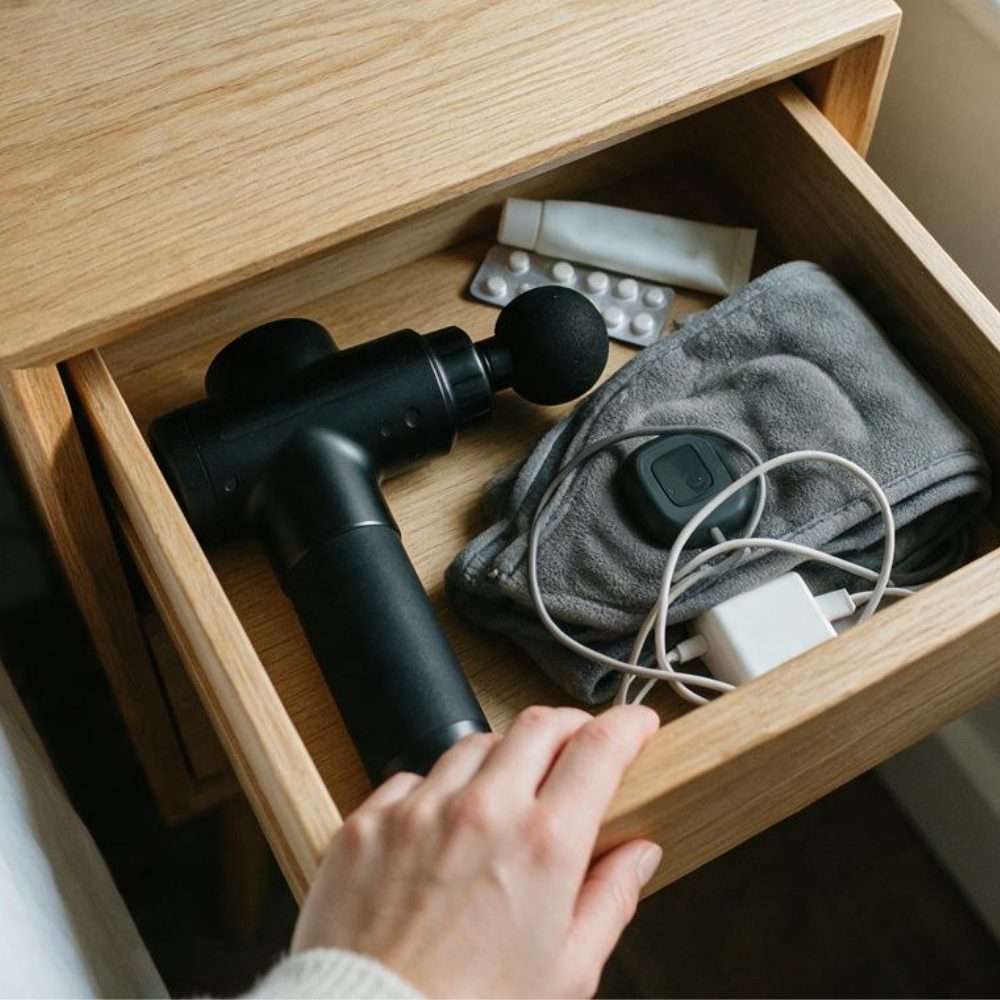
Everything in that drawer worked the same way. I held it against the knot, or leaned my weight into it, and waited. This one has nothing to hold. You lie back on it, and your hands have nothing to do.
My heating pad gave me heat, on the knot. My massage gun gave me vibration, on the knot. Neither one held my head back, and nothing in that drawer did all three at once, under my neck.
The angle. It holds your neck at 26 degrees, a fixed stretch position built into the shape of the device. It's designed to take pressure off your neck.
The heat. Three heat levels. Heat is meant to bring blood flow back to a muscle that has been tight for two years.
The vibration. Three vibration intensities, into the muscles either side of your neck, not against your shoulder blade, where my massage gun always went.
Fifteen minutes, lying down. It doesn't go on the knot. It goes under your neck.
I Skipped Straight To The Reviews About Shoulder Blades.
Before I ordered, I did what I always do. I looked it up.
4.2 stars on Trustpilot, from a little over a thousand reviews. I picked out the ones that sounded like me. One of them had read about the same idea I'd just been shown.
"I first read about the concept of releasing the knots of my shoulder blades by massaging the origination point in my neck."Dana Neufer, Trustpilot, unprompted review


"After just a few nights of using it, I can already feel a difference in the spasm between my shoulder blades."Pam Zoellick, Trustpilot, unprompted review


The envelope was still on the kitchen table. One visit on it was $150. The FisioRest was $89, in their Fall Sale.
I ordered it before I put the phone down. Then I told myself, out loud, not to expect anything. I'd been let down enough times to know better.
My husband, who was pretending to be asleep, said, "Noted."
When it came, I lay back on it on the couch that first night. Heat on the lowest of its three settings, vibration on low. The warmth came up under the back of my neck. The padded sides hummed against the muscles on either side, nowhere near the knot. It switches itself off, so I didn't have to worry about drifting off. My husband says I was asleep within minutes, the way I nearly was on her table.
It runs off a USB cable, not a battery, so it lives at the end of the couch by the outlet.
Week One, I Still Reached Back For It. There Was Less To Press On.
The first week, the thing I noticed wasn't the pain. It was that I kept reaching back out of habit and finding less to press on.
The second week, the nail stopped showing up by the afternoon. I was at my desk one morning and realized I'd gone hours without thinking about my shoulder blade at all.
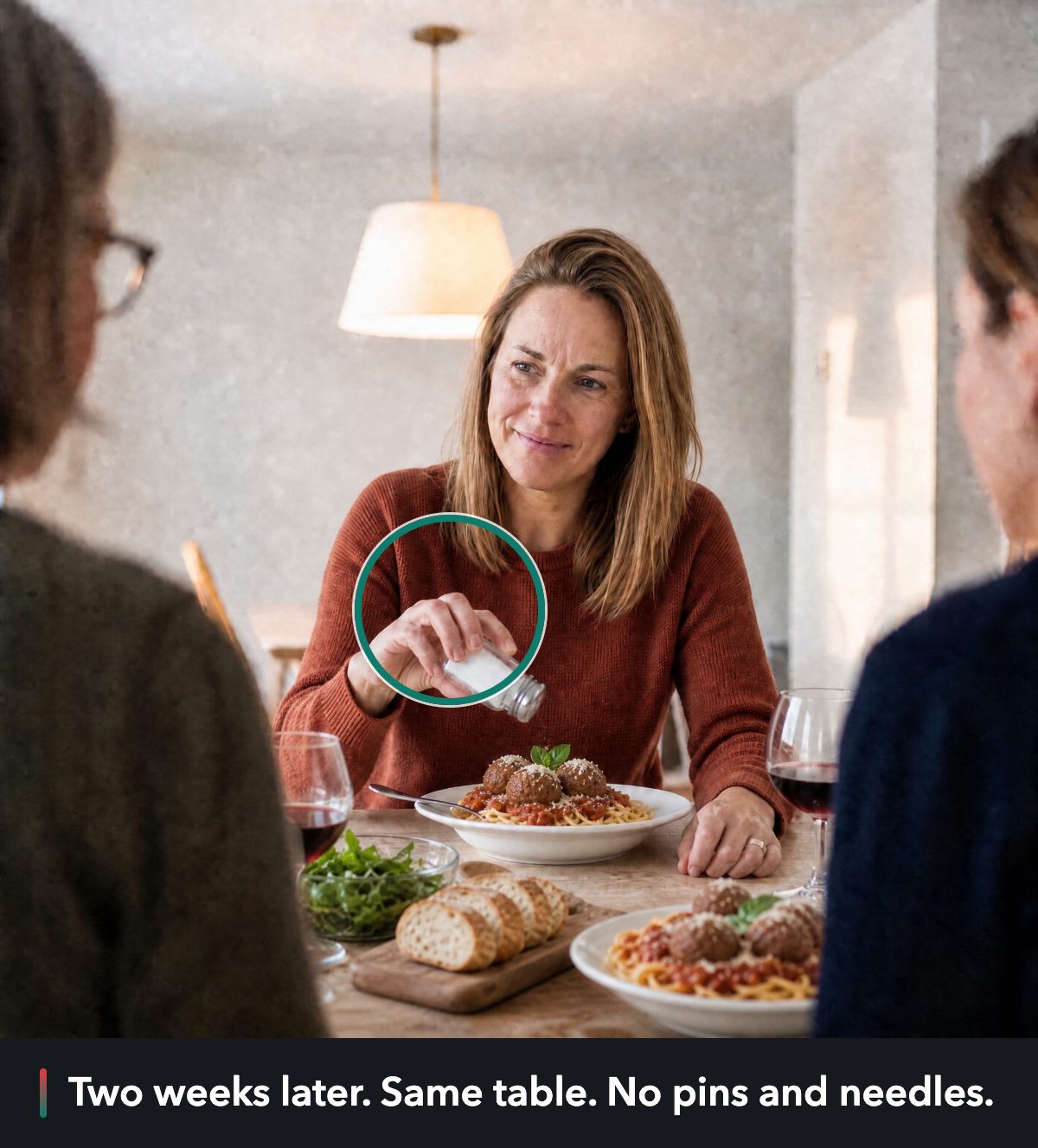
That Sunday we had friends over again. I reached across the table for the salt.
My hand was fine. No pins and needles. No that-feeling-is-coming warning.
I sat there holding the salt for a second, waiting for it to catch up with me. It didn't.
I still use it most evenings. Fifteen minutes, usually while the news is on.
I'm not going to tell you my back is brand new, or that it never twinges. But the thing that used to stop me in the middle of a sentence doesn't anymore.
Two more from Trustpilot, in their own words.
"I've been dealing with pain near my left shoulder blade for over a year. Going to the chiropractor helps but it usually only lasts a few days, then it's time for another adjustment. That was starting to get expensive! I started using the FisioRest for 15 minutes in the evenings and 15 minutes in the morning for the past few weeks and have noticed that I'm not in quite as much as pain as I was before…"Linda, Trustpilot, five stars
"After using it 15 plus minutes a day for just one week, my neck and the muscles between my shoulder blades and spine definitely feel less tense and less painful."Mark B., Trustpilot, five stars
Same Red Light. He Looked Over Twice Before He Said Anything.
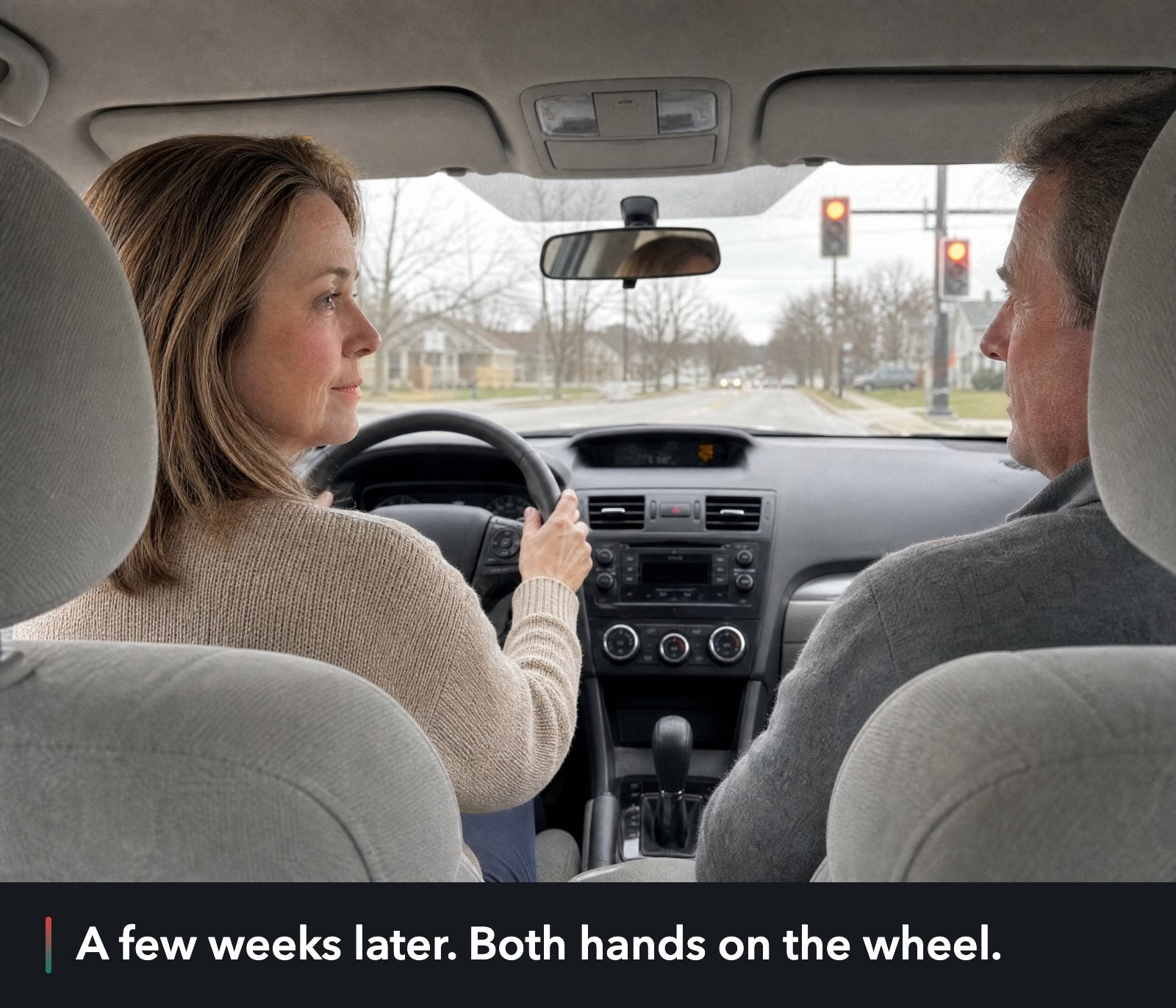
A few weeks after that we were stopped at the same red light, on the way home from the same grocery store.
My husband looked over at me. Then he looked again.
"You're not doing it," he said.
I looked down. Both my hands were on the wheel.
I hadn't noticed. That was the whole point. I hadn't noticed for days.
If Your Hand Went To The Spot While You Were Reading This
If this is you:
- A spot at the inner edge of your shoulder blade, right by your spine, that you can find in the dark.
- Some days it's tight, some days it burns. It's worse by the evening, and sometimes sends pins and needles down your arm.
- A massage, a ball or a gun can quiet it for a day, an hour, forty minutes. By morning it's back in exactly the same place.
- Your hand goes there without you deciding to, the way mine did at that red light for two years.
Then I'd tell you what she told me. It might not be your shoulder blade at all. It might be a nerve in your neck that nobody has checked.
Here's what I'd do. Get a FisioRest and give it a month of evenings before you decide anything. If you've had neck surgery or have a diagnosed neck condition, ask your doctor before you use it. The link is below.
Where Is Your Hand A Year From Now?
- On the spot at the red light.
- Pins and needles reaching for the salt.
- Back by morning, in exactly the same place.
- Fifteen minutes a day, lying back.
- Under your neck, not on your shoulder blade.
- 365 days to try it. Refund terms apply.
Other FisioRest customers sent in photos with their reviews. Not one of them has it on a shoulder blade.


About the guarantee, plainly. You get 365 days to try it at home, and if it doesn't help, you can ask for a refund.
The full terms are in their refund policy.
The knot may not be in your shoulder blade at all.
P.S. The short version, if you skipped down here. For two years I dug at a knot that always came back to the same spot. The first real change came from somebody working a hand's width higher, on my neck. FisioRest is how I do something similar at home, fifteen minutes most evenings, lying back. It's $89 in their Fall Sale, with 365 days to try it at home.
P.P.S. My husband has started using it in the evenings, and I now have to book a slot on my own couch.