
5 Reasons Why This At-Home Neck Device Is Changing The Way People Manage A Shoulder Blade Knot
Your shoulder blade doesn't turn when your head does. So why does that knot so often catch when you check your blind spot?

The light turns red, and your hand is already back there. Arm across your chest, fingers hooked over the top of your shoulder, reaching for the spot at the inner edge of your shoulder blade, where that deep, stubborn knot feels like a nail pressed into your back. Your hand goes there at the sink, too. At your desk. Halfway through a sentence, before you even notice.
It's tight when you wake up and tighter by dinner. On the bad days it burns.
You've had someone dig an elbow into it while you told them harder. You've leaned into the corner of a wall and rolled on it. It let go for a while. Then, by morning, the knot was back in the exact same spot.
That pattern is the clue. Below are 5 reasons it keeps coming back, and why the cause is often not where you've been digging.
1For Many People, A Massage Lasts About A Day. The Tennis Ball, About An Hour. So Why Won't It Stay Gone?
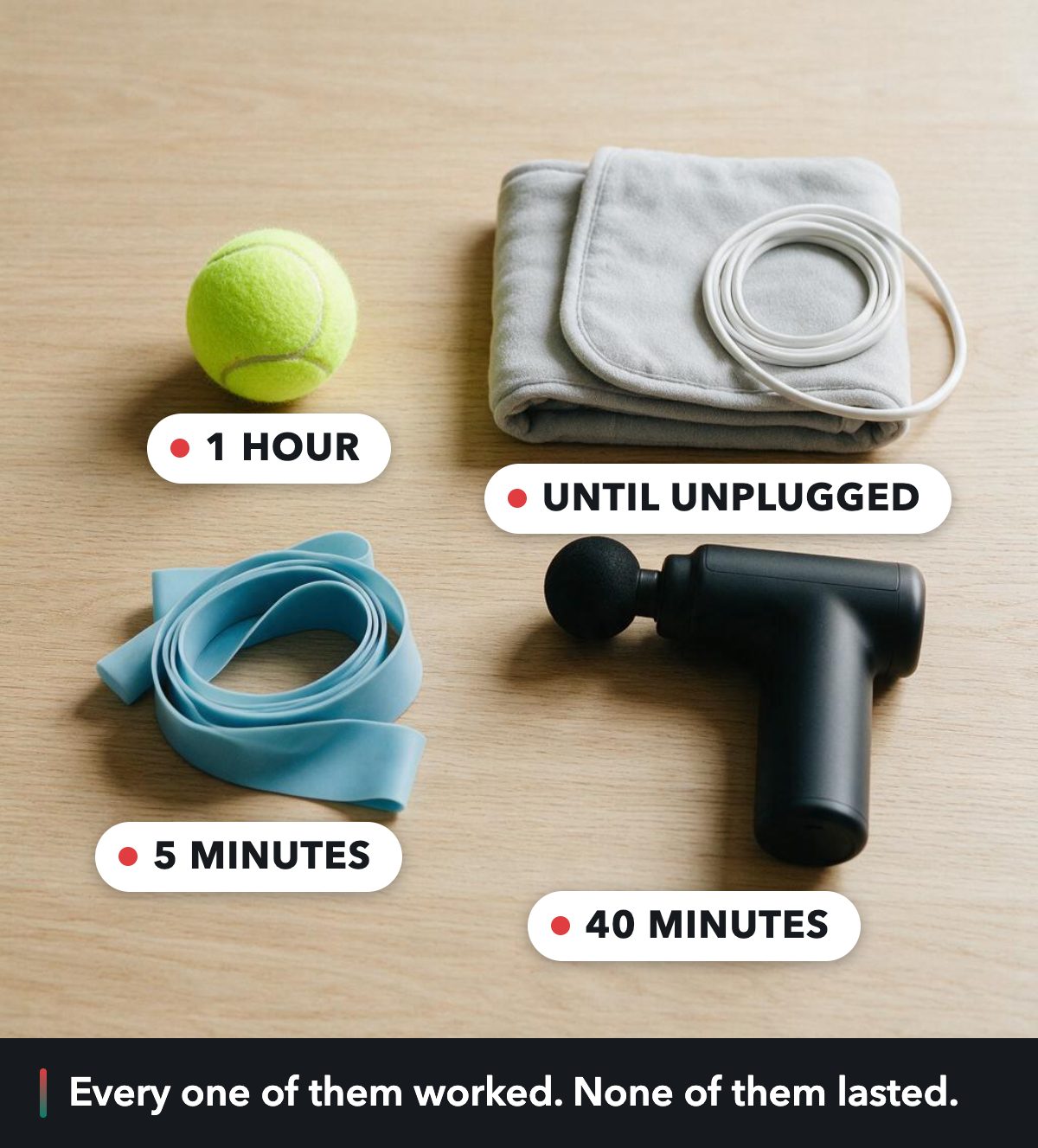
And here's the strange part. It doesn't come back near where it was. It comes back to the exact same spot, as if something keeps putting it there.
A knot you've worked out should stay worked out. This one doesn't, and that's the first clue the cause might not be the muscle at all.
2You Were Told It's A Muscle Strain, Or Your Posture. Every Answer Aimed At The Knot.
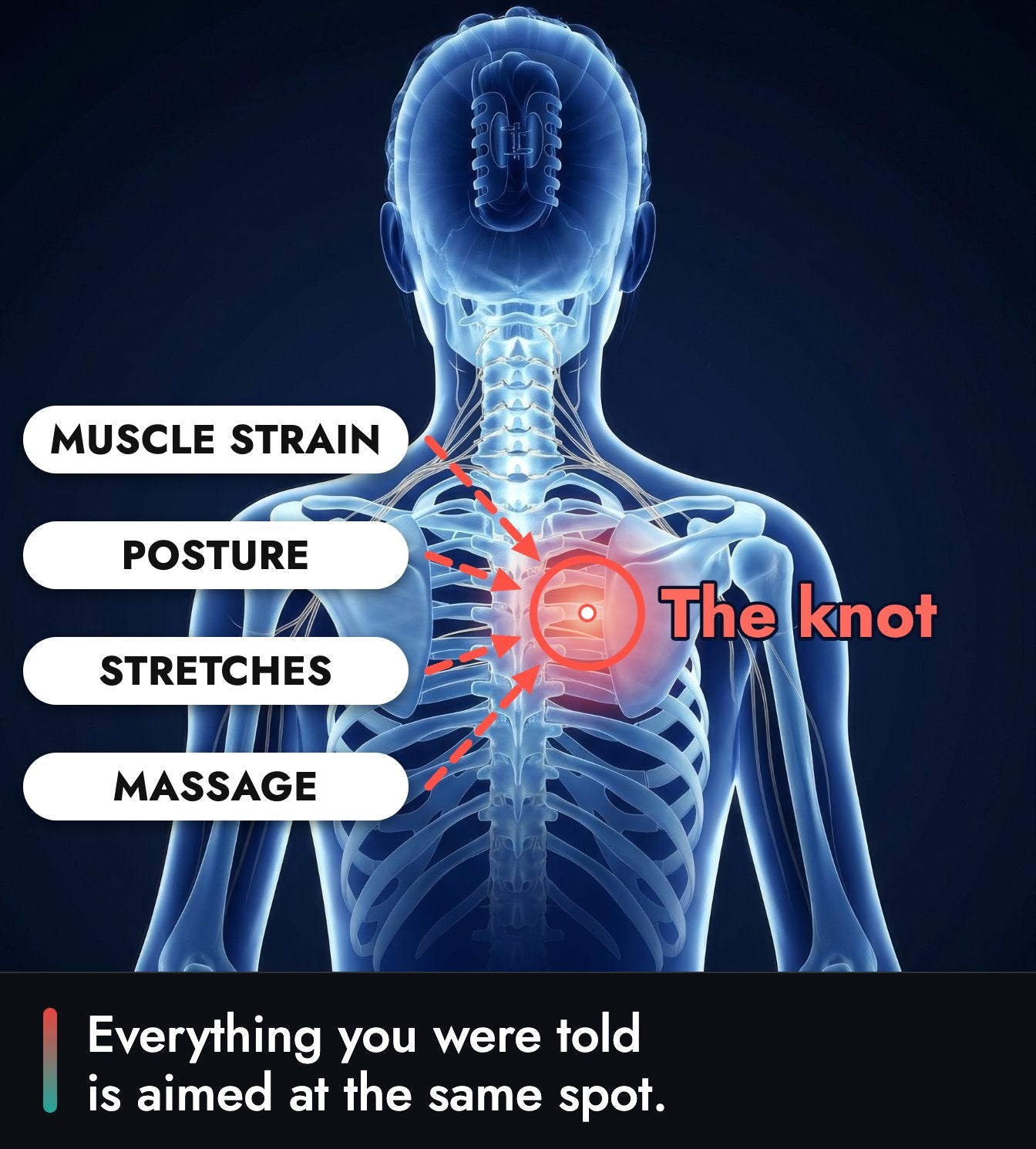
"It's the way you sleep." "It's stress." "It's a rhomboid strain." "Sit up straight." "Stretch more." "Get a massage."
So you did. A new pillow. Reminders to sit up straight. Stretches every morning. And when none of it held, month after month, you started to wonder if you were doing them wrong. Then you stopped bringing it up. Somewhere along the way you decided this is just how your upper back is now.
Look at what all that advice has in common. It treats the knot as the problem. Nobody asked what keeps putting it there.
3It Catches When You Turn Your Head. Your Shoulder Blade Doesn't Turn. Your Neck Does.
Check your blind spot before you change lanes. Turn to see who just walked in behind you. That's often when the spot catches.
But your shoulder blade doesn't move when you turn your head. Your neck does.

And if it ever sends tingling down your arm and into your fingers, that's the same clue. The nerves that reach your arm start in your neck too.
4The Spot You Keep Pressing Is Where A Nerve From Your Neck Ends
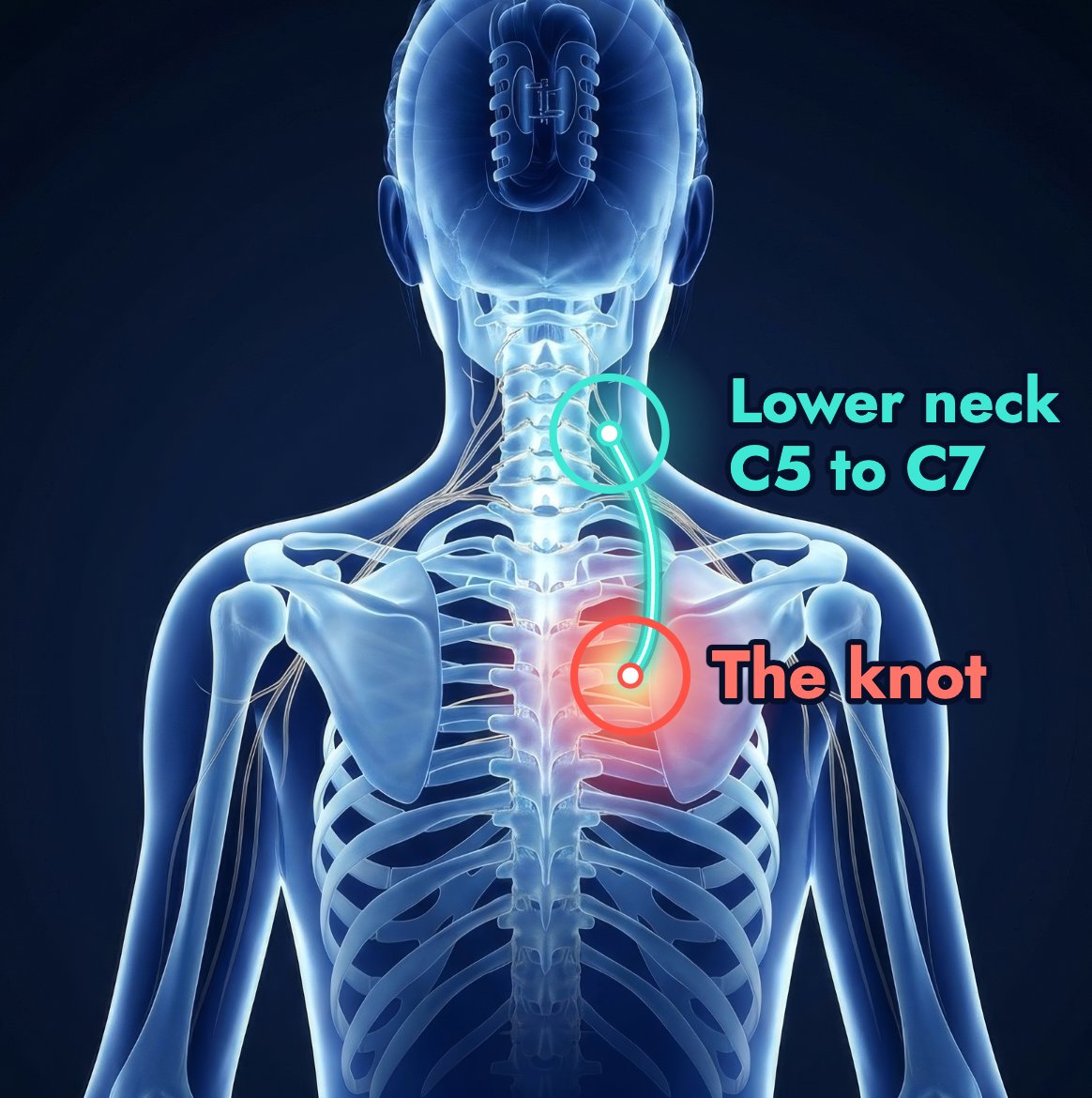
Remember "a rhomboid strain"? The rhomboid is real. It's the muscle along the inner edge of your shoulder blade, right where you keep pressing. But every muscle runs on a nerve, and this one has a name you were probably never told: the dorsal scapular nerve. It doesn't start in your back. It most often starts in your neck, at the fifth nerve root, and runs down to the inner edge of your shoulder blade. Other nerves from your neck keep going, down your arm.
So when a nerve is squeezed in your neck, whether by a shifted disc, worn bones or tight muscle, you won't always feel it in your neck. You can feel it where the nerve ends. That may be why you can find the spot in the dark. You may have been treating where you feel it, not where it's coming from.
 The pinchWhere you feel it
5Your Thumb Can Make That Hard Lump Let Go. It Doesn't Change Where It May Start.
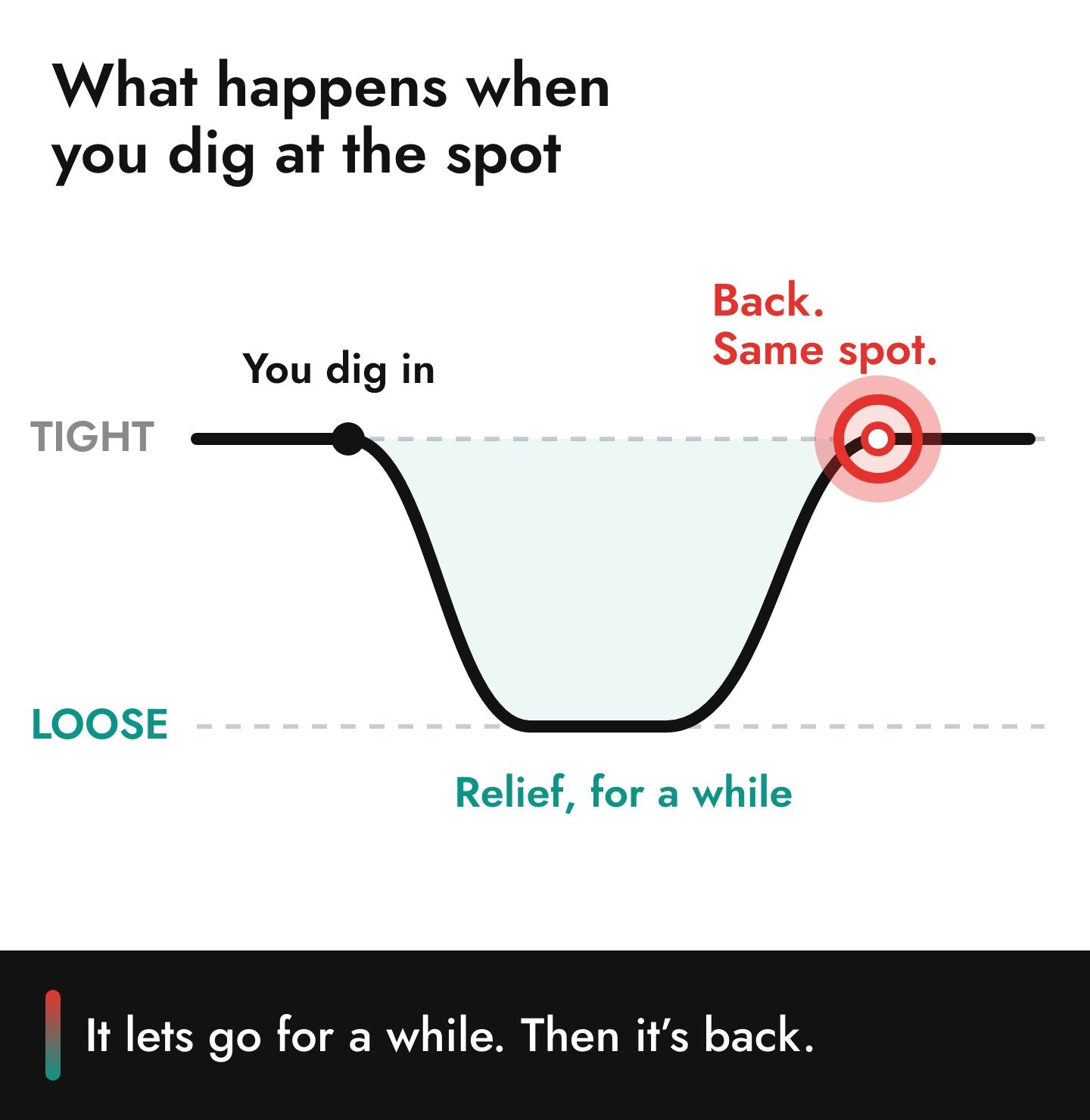
You ask for harder. Then harder again, until whoever is pressing says they can't. And the hard lump still comes back, just as solid.
Here's one explanation that fits. When a nerve is irritated, the muscle it runs to may tighten to protect the area. A muscle held that tight can feel like something solid under the skin.
Dig in and it lets go, so it feels good. But if a nerve in your neck is still being squeezed, the muscle may tighten right back up. That would also fit the days you're even sorer after a massage, and the days you wonder if all that digging is making it worse.
So none of it was wasted, and none of it was your fault. Every fix worked on the spot you could reach. That may not be where it starts.
When It Starts In The Neck, Treatment Goes To The Neck
In that case, a clinic course can combine:
- Neck traction, which a 2018 review of five trials found may ease pain when it's added to physical therapy
- Heat, to loosen the muscles that have been tight for years
- Targeted massage, to release the deep tension underneath
The catch is the cost. A clinic course is usually two or three visits a week, at about $80 to $150 a visit:
Plus the drive, the parking and the waiting room, every time.
None of that review's trials tested FisioRest.
Traction source: Romeo A, Vanti C, Boldrini V, et al. Cervical radiculopathy: effectiveness of adding traction to physical therapy. Phys Ther. 2018;98(4):231-242. PubMed
FisioRest Goes Under Your Neck, Not On Your Shoulder Blade
A team of physical therapists and engineers asked a simple question: what if you could get something similar at home, without the appointments or the weekly bill?
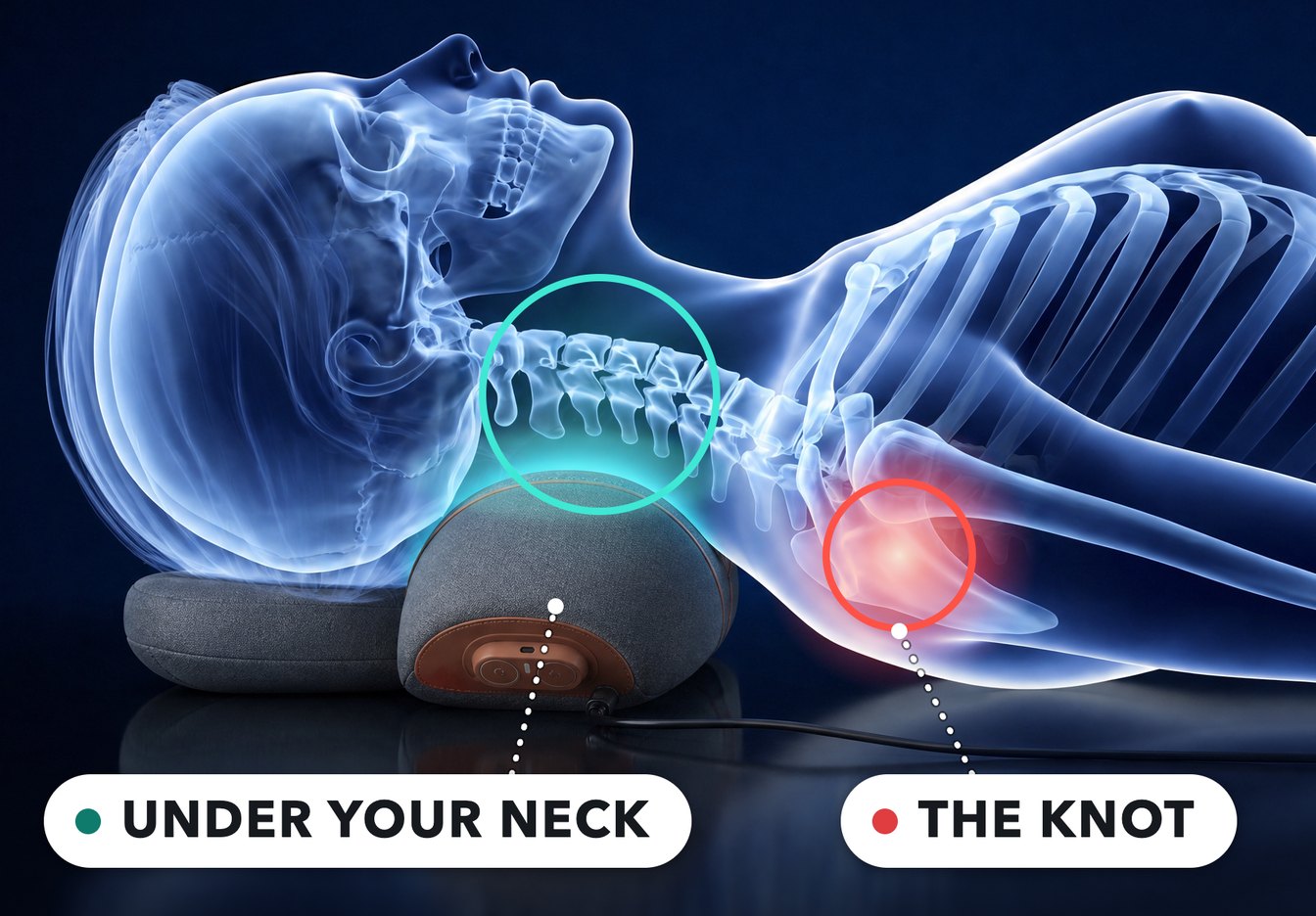
It doesn't touch the spot you've been digging into. It's aimed at the neck, where that spot may start.
FisioRest is a 3-in-1 device you lie back on for 15 minutes a day:
- Neck traction at a fixed angle, set at 26 degrees and built into the shape of the device, to ease the strain on your neck
- Heat at three levels, to loosen the tight muscles at the back of your neck
- Targeted vibration into the muscles either side of your neck, the ones a massage gun at your shoulder blade was never reaching
Yes, it looks a bit like a pillow, and you've already tried a new pillow. A pillow holds your head while you sleep. This holds your neck at a fixed 26 degree angle, built into its shape, for 15 minutes, with heat and vibration working on the muscles either side of your neck.
Look at what you already own. A heating pad gives you heat, on the knot. A massage gun gives you vibration, on the knot. Neither one holds your neck at an angle, and neither does all three at once.
And it isn't one more thing digging in. You lie back and it works at the level you set: heat has three levels and vibration has three intensities, so you can start on the lowest. It also shuts itself off. It runs on a USB cable rather than a battery, so set it up near an outlet or a power bank. If you've had neck surgery or have a diagnosed neck condition, ask your doctor before you use it.
SEE THE FALL SALE PRICE →It Isn't Instant. Here's What Buyers Noticed, In Order.
In buyers' own words, from a few nights in to a few months in.
On Trustpilot
After just a few nights of using it, I can already feel a difference in the spasm between my shoulder blades.Pam Z., Trustpilot
I first read about the concept of releasing the knots of my shoulder blades by massaging the origination point in my neck. I was intrigued, and frankly ready to try anything. After several days of 30-minute therapy, I can feel a noticeable release.Dana N., Trustpilot
I’ve been using FisioRest every day for 5 days at this point, and wow, I’m already noticing a difference! My neck feels longer and my posture less and less hunched after each use, which then in turn eases the ‘knot’ feeling in my shoulder blade which has been bothering me for so long.Elodie M., Trustpilot
After using it 15 plus minutes a day for just one week, my neck and the muscles between my shoulder blades and spine definitely feel less tense and less painful.Mark B., Trustpilot
I have used it for 13 days for 30 min (or more!) every day. From the very first time of using it, my neck has been looser and has felt great!!!! I still have some tightness in my shoulders and my knot under my shoulder blade is still there, but it is definitely improving.Jenny S., Trustpilot
I’ve been dealing with pain near my left shoulder blade for over a year. Going to the chiropractor helps but it usually only lasts a few days, then it’s time for another adjustment… I started using the FisioRest for 15 minutes in the evenings and 15 minutes in the morning for the past few weeks and have noticed that I’m not in quite as much as pain as I was before…Linda, Trustpilot
And from customers who sent a photo

I was experiencing neck pain several days a week; I’ve had this since about 7/13 (today is 8/11) and haven’t experienced it since. Combined with neck stretches, this thing is amazing and well worth the money. 15 mins a day really does make a differenceJuan C., customer review

I work long hours at a desk, and by the end of the day, my neck feels stiff and achy… I’ve tried various remedies like neck pillows and ergonomic chairs, but they didn’t provide much relief. I was skeptical about Fisiorest at first and figured I’d return it if it didn’t work. After a few months of using it, I’m very impressed!Mark C., customer review

I used to wake up with neck, shoulder, and arm pain… Sometimes the pain was so sharp that I could barely hold a cellphone or a water bottle… now I can sleep better at night and wake up with minimal, if any, pain.Lillian F., customer review

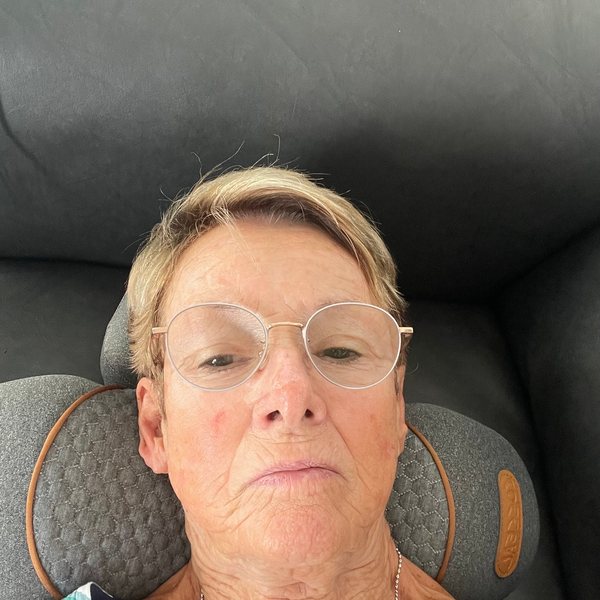

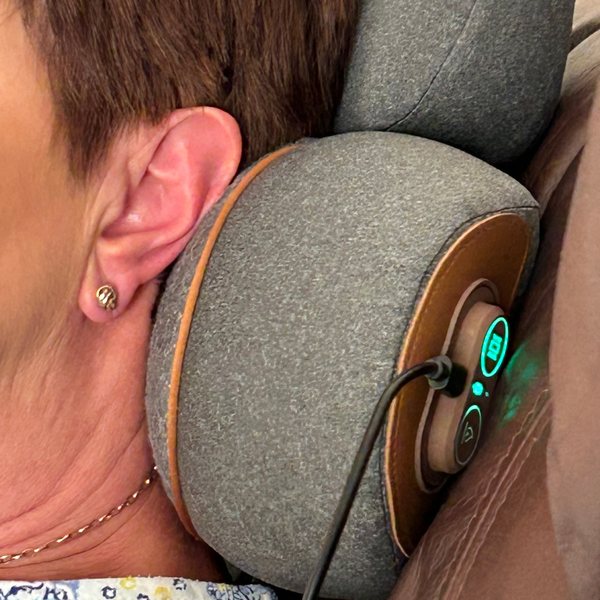
Customers who sent a photo with their review.
Aim At The Knot Again, Or At The Neck?
- Massage: about a day.
- Tennis ball: about an hour.
- Massage gun: about forty minutes.
- Goes under your neck, not on your shoulder blade.
- Traction, heat and vibration. 15 minutes, lying back.
- No appointments. No weekly bill.
FALL SALE
$89, Down From $199
If you want a day where your hand doesn't go looking for that spot, aim at your neck this time.

- Neck traction at a fixed 26°, three heat levels, three vibration intensities
- 15 minutes a day, lying back
- Free guide with neck exercises included ($29 value)
- 365 days to try it at home
I was hesitant, but figured it costs as much as a massage, so I had little to lose. It does release the tension from my shoulder to my neck. Using consistently is key.T.S., Trustpilot
Refund terms apply. See their refund policy.
P.S. Did your hand go back to that spot while you were reading this? That's the habit this whole page is about. If nothing changes, the knot will probably be there again when you wake up, in the same spot. FisioRest goes under your neck instead, 15 minutes a day, with 365 days to try it at home. See the Fall Sale price →